Tuesday, September 10, 2013
EEWeb Embedded Developer Magazine
EEWeb has released the first issue of a new monthly magazine targeting the embedded space. EEWeb Embedded Developer can be read online or downloaded in pdf format. The premiere issue covers NXP MCU ecosystem, a Rasperry PI primer (part 1), the Wandboard from Mouser, ARM CORTEX-A9, interviews and a 32-BIT MCU comparison. There are also short reviews of the BeagleBoard-xM, TI's Tiva C series Evaluation kit (ARM Cortex-M4F-based MCU), and the LPC812-LPCXpresso Board.


Tuesday, July 9, 2013
Raspberry Pi Magazine
EEWeb has dedicated an issue of the EEWeb Pulse to the Raspberry Pi. See Pulse Issue 106, July 9th, 2013 (The cover currently shows the wrong year, 2012). It features an interview with founder Eben Upton and pi projects.
Wednesday, February 13, 2013
STM32F4 Discovery Kit Expansion
The $14 STM32F4 Discovery kit with ARM Cortex-M4 Processor can be expanded with three new boards. There is a baseboard that provides Ethernet, Micro SD, plus more I/O ($40), an LCD board with touchscreen ($55), and a camera module for video or photos ($34). See element14 for more information on the Discovery series boards.


Friday, February 1, 2013
New Microsemi ARM uClinux Starter Kit
Microsemi's SmartFusion2 Starter Kit includes a small ARM SoC FPGA module and a baseboard for user interfaces and expansion. The kit is $299 but if you attend an Avnet Electronics Marketing Microsemi SpeedWay Design Workshop ($99) you receive a kit at no additional cost. The SmartFusion2 SoC integrates a 166 MHz ARM Cortex-M3, accellerators for DSP, security and communication interfaces on a single chip. The Microsemi press release for the starter kit has a nice summary of features for the development board and the SoC itself.

The module itself is an Emcraft Systems mezzanine form factor system-on-module (M2S SOM), you can find more information about the M2S SOM, including documentation and baseboard schematics, at Emcraft's website. The development sysetem will run uCLinux, and boasts a 0.5sec boot (to console prompt) in this video:

The module itself is an Emcraft Systems mezzanine form factor system-on-module (M2S SOM), you can find more information about the M2S SOM, including documentation and baseboard schematics, at Emcraft's website. The development sysetem will run uCLinux, and boasts a 0.5sec boot (to console prompt) in this video:
Wednesday, January 23, 2013
Data Logger Development Boards
In my search for a small, powerful, and inexpensive data logger I came across a few interesting development boards.
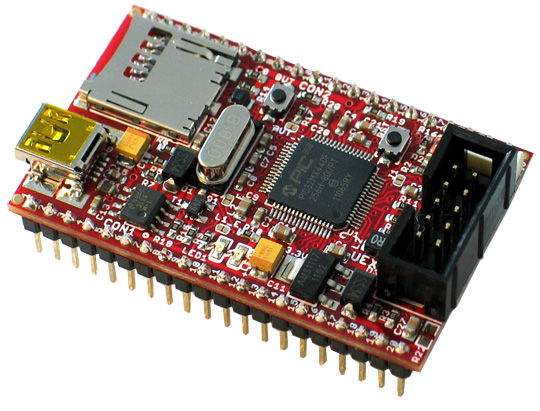
PIC32-PINGUINO-MICRO
This Maple-like board features a Microchip PIC32MX440F256H 80 Mhz microcontroller and a 16-channel 10bit ADC (only 11 channels are available on this board). It can sample at 1MSPS and can perform conversions in sleep and idle modes. The price is very reasonable too at 12.95 EUR (<$18USD). The UEXT connector allows you to add Olimex modules for a wide variety of peripherals and interfaces. Modules are available for interface, adapters, sensors, LCD, IO, video, RF. RFID, Ethernet, time, GPS, MP3 and Biofeedback.
FEZ Domino was on this list because of the price and small size but it has now been discontinued.

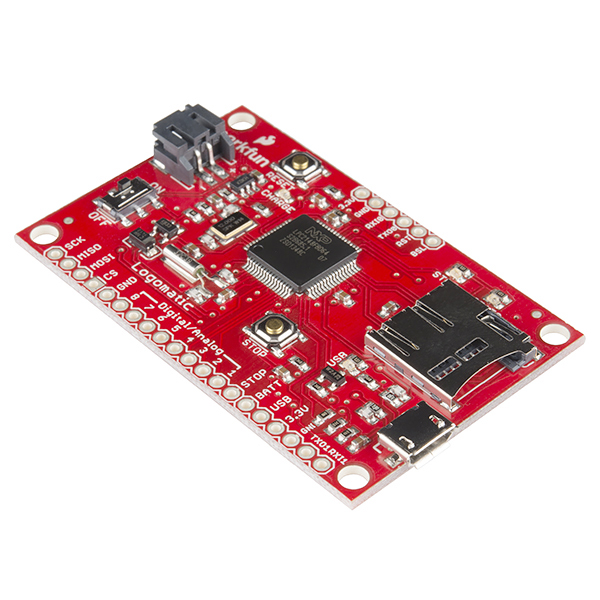
One of sparkfun's more popular products, the Logomatic V2 has a simple design and fewer features than the rest and is a little more expensive ($59.95). It uses the 60MHz NXP LPC2148 ARM7 and you can find a lot of open source code examples on the net. The board comes with the main logging firmware on Github, and SparkFun's USB bootloader, you can modify the source of either project using free WinARM GNU tools. Jean-Sebastien Stozel developed a few projects to extend the firmware including a generic C++ multitasking framework using FreeRTOS.
PIC32-PINGUINO-MICRO
This Maple-like board features a Microchip PIC32MX440F256H 80 Mhz microcontroller and a 16-channel 10bit ADC (only 11 channels are available on this board). It can sample at 1MSPS and can perform conversions in sleep and idle modes. The price is very reasonable too at 12.95 EUR (<$18USD). The UEXT connector allows you to add Olimex modules for a wide variety of peripherals and interfaces. Modules are available for interface, adapters, sensors, LCD, IO, video, RF. RFID, Ethernet, time, GPS, MP3 and Biofeedback.
ADI part number EVAL-ADXL345Z-DB ($59.00) This datalogger isn't as powerful with only a 40+MHz ARM7-based ADuC7024 MCU, but has a lot of features. The MCU itself has a multichannel, 12bit, 1 MSPS ADC, voltage reference, temperature sensor, voltage comparator, up to 4 DACs, power supply monitor, PLA and 3-phase 16bit PWM generator. The board can be powered by two AAA batteries, and includes a 3-axis accelerometer, the ADXL345. The development environment for the sample code requires a evaluation version of the compiler, but there are GNU tools available for the processor.
Tuesday, January 15, 2013
TI BoosterPack Design Challenge
Enter an original BoosterPack plug-in board to win prizes including a trip to DESIGN West 2013 in the 2013 Texas Instruments MCU BoosterPack Design Challenge. The Build Your Own BoosterPack program supports Texas Intsruments LaunchPad evaluation platforms. TI also encourages you to have your design manufactured and distributed by manufacturers like Seeed Studio. Finished BoosterPacks can be added to the BoosterPack wiki list where it can be promoted to the official www.ti.com/boosterpack page.

Monday, January 14, 2013
Renesas Offering Free Micruim RTOS
Commercial products using 32-bit RX and 16-bit RL78 MCUs can qualify for a free Micruim RTOS license until March 31, 2013. This can be uC/OS-II or uC/OS-III and middleware (TCP/IP, USB, File System), plus uC/GUI. The promotion is called 'The Power of 2' and is available in the Americas. See the video below for more information, it also mentions how NASA uses uC/OS-II on the Mars Rover.
The Micruim website just completed a major update, they now have free PDF books and example projects with registration. They are also offering free live training classes in Micrium's office in Florida.
The Micruim website just completed a major update, they now have free PDF books and example projects with registration. They are also offering free live training classes in Micrium's office in Florida.
Monday, January 7, 2013
Start-up Develops Wireless iPod Controller for Smartphones
A former client, Tau Cygnus, sent me a note that a prototype I helped develop is ready for production. The Cyborg dock makes use of an iPod and a smartphone (or tablet) to connect your audio system and to control it wirelessly. The free app works with Apple, Android, Kindle Fire and Nook devices. The iPod dock connects directly to your music system so there is no streaming or buffering of the audio. The app runs on your wireless phone or tablet to browse and control playback remotely. Visit www.cyborgdock.com for more details and see the video embedded below. There is currently a funding campaign at www.indiegogo.com/cyborgdock to help start production. In case you are wondering, I'm no longer working for Tau Cygnus and I'm not receiving any compensation for this post.
If you want to expand the capabilities of the Cyborg, "...we have opened up Cyborg for developers. An API
is provided so third party developers can customize Cyborg - the API is
provided for both Android and Apple platforms. Of course our base
station software that you helped with is under the GNU license, so that
is provided as well" (President of Tau Cygnus, Greg Smolinski). For my part, I reviewed the schematics and layout, performed the board bring-up (not too much smoke), ported the bootloader, and ported the Linux OS to the system. It looks like a lot of additional work has been put into this since those early prototypes were completed. When you contribute to a project like this, it is great to see the finished product. I hope it does well and people will enjoy using it.
Monday, November 19, 2012
BeagleBone Design Contest
Design a new plug-in board for the BeagleBone CapeContest to win $1000 and production by Circuitco. The contest deadline is December 31, 2012, with the top three winning the Grand Prize which includes the above plus an analyzer from Total Phase. Entry requirements are a schematic, bill of materials and YouTube video describing the cape. Weekly prizes are also be available including Total Phase tools, Adafruit ProtoCapes, and MetaWatches from Mouser. There are already two submissions, a Geiger cape and a CollRunner-II CPLD cape, you can see them here.
Friday, October 5, 2012
Atmel Launches Family of Power Efficient ARM Microcontrollers
Atmel SAM4L processors target designs that need both performance and low power usage. An evaluation kit is available for $149 at the Atmel store with an integrated power meter.
 This family uses the ARM Cortex-M4 processor which has the highest performance in the Cortex-M family and includes control and signal processing capabilities. For pricing and availability see this Atmel press release.
The SAM4L-EK evaluation kit features an ATSAM4LC4C with 256K flash and 48MHz max clock frequency. The kit includes an on-board Segger J-Link, capacative touch area, USB device connector, light sensor, audio jack, segmented LCD, a wireless interface header and an add-on board header for Atmel Sensors Xplained boards. A unique feature of this board is the real-time power monitoring section with OLED color display.


SAM4L-EK: Overview
The SAM4L-EK evaluation kit features an ATSAM4LC4C with 256K flash and 48MHz max clock frequency. The kit includes an on-board Segger J-Link, capacative touch area, USB device connector, light sensor, audio jack, segmented LCD, a wireless interface header and an add-on board header for Atmel Sensors Xplained boards. A unique feature of this board is the real-time power monitoring section with OLED color display.

Subscribe to:
Posts (Atom)


