Showing posts with label Android. Show all posts

Wednesday, July 17, 2024

Ezurio Development Board Kit Giveaway

Ezurio (formerly Laird Connectivity) is offering a development kit giveaway that includes a System on Module (SOM), a carrier board, a wireless module, and an antenna. Ezurio specializes in SOMs featuring NXP i.MX processors, including the i.MX 8M Mini, 8M Plus, and i.MX 93, with support for both Android and Linux. The giveaway also includes Sona WiFi 6/6E and Bluetooth LE modules.


Wednesday, January 23, 2013

Data Logger Development Boards

In my search for a small, powerful, and inexpensive data logger I came across a few interesting development boards.

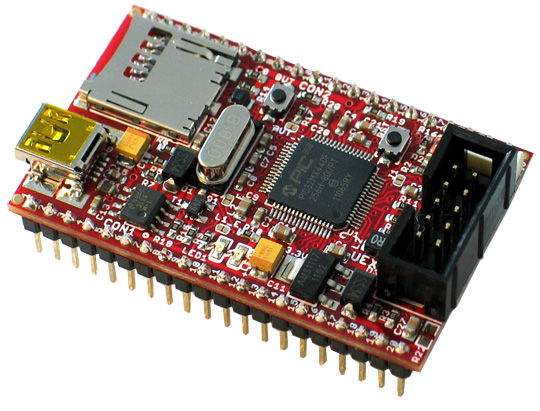
PIC32-PINGUINO-MICRO
This Maple-like board features a Microchip PIC32MX440F256H 80 Mhz microcontroller and a 16-channel 10bit ADC (only 11 channels are available on this board).  It can sample at 1MSPS and can perform conversions in sleep and idle modes. The price is very reasonable too at 12.95 EUR (<$18USD).  The UEXT connector allows you to add Olimex modules for a wide variety of peripherals and interfaces.  Modules are available for interface, adapters, sensors, LCD, IO, video, RF. RFID, Ethernet, time, GPS, MP3 and Biofeedback.


FEZ Domino was on this list because of the price and small size but it has now been discontinued.


ADI part number EVAL-ADXL345Z-DB ($59.00)  This datalogger isn't as powerful with only a 40+MHz ARM7-based ADuC7024 MCU, but has a lot of features. The MCU itself has a multichannel, 12bit, 1 MSPS ADC, voltage reference, temperature sensor, voltage comparator, up to 4 DACs, power supply monitor, PLA and 3-phase 16bit PWM generator.  The board can be powered by two AAA batteries, and includes a 3-axis accelerometer, the ADXL345.  The development environment for the sample code requires a evaluation version of the compiler, but there are GNU tools available for the processor. 


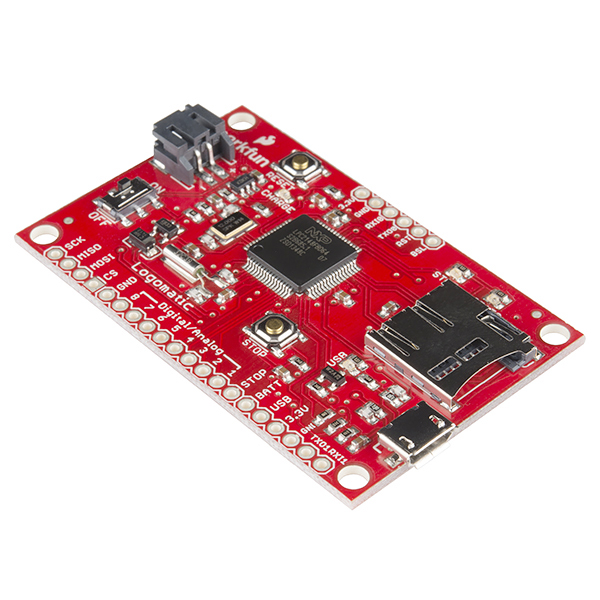
One of sparkfun's more popular products, the Logomatic V2 has a simple design and fewer features than the rest and is a little more expensive ($59.95).  It uses the 60MHz NXP LPC2148 ARM7 and you can find a lot of open source code examples on the net.  The board comes with the main logging firmware on Github, and SparkFun's USB bootloader, you can modify the source of either project using free WinARM GNU tools.  Jean-Sebastien Stozel developed a few projects to extend the firmware including a generic C++ multitasking framework using FreeRTOS.


Monday, January 7, 2013

Start-up Develops Wireless iPod Controller for Smartphones

A former client, Tau Cygnus, sent me a note that a prototype I helped develop is ready for production.  The Cyborg dock makes use of an iPod and a smartphone (or tablet) to connect your audio system and to control it wirelessly.  The free app works with Apple, Android, Kindle Fire and Nook devices.  The iPod dock connects directly to your music system so there is no streaming or buffering of the audio.  The app runs on your wireless phone or tablet to browse and control playback remotely.  Visit www.cyborgdock.com for more details and see the video embedded below.  There is currently a funding campaign at www.indiegogo.com/cyborgdock to help start production.  In case you are wondering, I'm no longer working for Tau Cygnus and I'm not receiving any compensation for this post.


If you want to expand the capabilities of the Cyborg, "...we have opened up Cyborg for developers. An API is provided so third party developers can customize Cyborg - the API is provided for both Android and Apple platforms. Of course our base station software that you helped with is under the GNU license, so that is provided as well" (President of Tau Cygnus, Greg Smolinski).  For my part, I reviewed the schematics and layout, performed the board bring-up (not too much smoke), ported the bootloader, and ported the Linux OS to the system.  It looks like a lot of additional work has been put into this since those early prototypes were completed.  When you contribute to a project like this, it is great to see the finished product.  I hope it does well and people will enjoy using it.

Saturday, June 30, 2012

Google Reimagines the Development Board

The ADK 2012 platform is packed with innovation and usable code for Android accessory development.


They advertise that all of the code is open source and with a less restrictive license like BSD so you can include it in your products. Here are the main libraries:
  • Bluetooth stack (BSD license) with libraries for RFCOMM, A2DP,L2CAP, SDP
  • Multimedia library including an ogg player
  • MicroSD SD/SDHC driver with FAT12/RAT16/FAT32
  • USB Host stack with Android open accessory protocol implementation

All of this runs on the Atmel SAM3X ARM Cortex-M3 processor with 512kB flash, 100kB RAM, and bluetooth is provide by a Texas Instruments CC2564. There are also sensors for light, proximity, acceleration, magnetism, temperature, humidity, barometric pressure, and other toys like a capacitive slider and buttons, RGB LEDs including the 7 segment display, a transducer speaker, and an NFC tag.

For more info, here is the developer's guide from google Accesory Development Kit 2012 Guide. A little more info about the Arduino IDE (for an ARM processor) it uses on the Arduino blog.

The surprise at the end of the video is that an ADK 2012 was given to each attendee of this talk, and the device is not for sale (yet). If you really want one, try e-bay, currently the best price is an auction at $400 US. If are lucky enough to have one here is the Android app from google play.

Wednesday, March 7, 2012

NXP Android Accessory Kit Includes Two ARM Development Boards

Embedded Artists and NXP have developed the Android Open Accessory Application Kit (AOAA).  The kit implements a USB host interface and the Android accessory protocol used by the Android Open Accessory Development Kit (ADK)  An added bonus to this $79 US development kit is an ARM Cortex-M0 board that is detachable from the main board and features the  NXP LPC11C24 microcontroller  The main board uses an ARM Cortex-M4 NXP LPC1769 that interfaces with the second ARM through a CAN interface.


Here is a video presentation from NXP about the kit.


To purchase the kit visit the embedded artists AOAA page, it can be purchased direct or through distributors including Digi-Key and Mouser.   The embedded artists page also includes documentation and software downloads.  In addition, there is a kit resource page at the LPCware NXP community.

Friday, January 13, 2012

Mouser Carrying Pandaboards

The PandaBoard is another powerful Texas Instruments Sitara ARM-based processor development platform like the BeagleBoard and BeagleBone. The video below shows it running Android 4.0 (Ice Cream Sandwich).


Now that Mouser is an authorized PandaBoard distributor, you can order all three boards at one place.  PandaBoard is also featured in the Mouser Product Knowledge Center, which gives it a dedicated page with more detailed information than for most products.  Currently, there are only about 2000 pages in the Product Knowledge Center and TI has over a hundred products listed including microcontrollers, sensors, evaluation modules and development boards.

Friday, December 30, 2011

Android ADK Development Boards

Developers using Google's Android Open Accessory Development Kit (ADK) now have more choices of hardware.  Initially the ADK supported the Arduino Mega2560 ($65 assembed from Adafruit) with Oleg Mazurov's USB Host Shield ($25).

Here is the current list from the Android Developers ADK page.

Arduino Mega ADK - available from the Arduino Store and Radio Shack $84.99


DIY Drones PhoneDrone Board for Android $99


mbed has a few solutions...


Microchip - Two boards are available, the PIC32 DM320412 (not yet for sale actually), and the PIC24 DM240415 $79.


Modern Device's Freeduino USB Host Board $79


RT Corp - RT-ADK&RT-ADS $389.03 (31,500 Yen)


Seeed Studio Seeeduino ADK Main Board $79


Sparkfun IOIO for Android (beta support) $49


Tuesday, December 13, 2011

Microchip Development Tool Sale

Microchip is having its annual end of year sale on select development tools.  You can save on boards from Microchip and third party tools sold at microchipDIRECT until January 5, 2012.  Included in the sale are the ICD3 in circuit debugger  for $152 US and the new accessory development starter kit for android for $65.


Monday, August 23, 2010

Consumer Devices Use Adobe Flash With Open Screen Project Technology

The Open Screen Project was created by Adobe to increase design-in of the Adobe Flash Player on consumer devices like cell phones.  Many companies are partners in the project including ARM, Cisco, Intel, Google, and Texas Instruments.  Microsoft and Apple are not on the list probably because they have competing technologies. Intel subsidiary Wind River recently joined the initiative.  Benefits to membership include a royalty-free license to use flash device run-times, and permission to use the Open Screen Project and Flash logo.

This video shows a Flash player running on an Android phone.


There is an Open Screen Project Fund sponsored by Adobe and Nokia.  It awards grants to develop Flash  applications that run on Nokia devices.

Thursday, March 11, 2010

Embedded Linux Conference 2010

The CELF Embedded Linux Conference is coming up on April 12th-14th, 2010 in San Francisco. Topics include Android, security, debug and real-time development. Here are a few titles:

Android: A Case Study of an Embedded Linux Project

Using a JTAG to Debug Linux Device Drivers

Creating a Secure Router Using SELinux

Effective Use of Scripting in Embedded Devices

FSCE: Reducing Context Switching Time on ARM

Understanding Threat Models for Embedded Devices

Experiences in Android Porting, Lessons Learned, Tips and Tricks

Case Study - Embedded linux in a Digital Television STB

Understanding and Developing Applications for Maemo Platform

PIO: Talking to the Outside World

Linux Without a Boot Loader?

Wednesday, October 21, 2009

Tuesday, October 20, 2009

Barnes and Noble will release electronic reader

Gizmondo and the Wall Street Journal are reporting that Barnes and Noble will release the Nook, an electronic reader to compete with Amazon's Kindle. It's reported to sell for $259, and run Google's Android OS. Gizmondo has pictures but no specifications yet.

Tuesday, September 15, 2009

Texas Instrument's OMAP and Inexpensive BeagleBoard Excel with Embedded Linux

Attending the TI Tech Days Toronto 2009, I was impressed with the capabilities of the BeagleBoard, an OMAP3530 single board computer that sells for only $149. It was on display serving video to a tiny DLP projector that is also available as a development kit from TI.

The BeagleBoard is a reference platform as well, with all schematics, gerbers and even design files available online. This allows third-parties like TinCanTools to develop a peripheral add-on board an an adaptor for their USB-JTAG board to support the BeagleBoard.

The OMAP is a great platform for Embedded Linux development. The OpenEmbedded project, the Angstrom distribution, and Android all have been ported to the OMAP, and there is a great community of BeagleBoard Linux users and a wealth of information online at BeagleBoard.org. In addition to the BeagleBoard, there are OMAP development boards from gumstix and Logic. Each of these boards also have embedded Linux distributions and online resources for developers.

At the Conference, the room was full for the OMAP embedded Linux presentation by Nuvation, and it could have lasted much longer if time permitted. Developers had many questions on each slide and the presenter had to rush to finish. You can tell that there are a lot of products in development with the technology or at least considering OMAP and Embedded Linux as a solution.

There were a number of development companies at the conference (including Aaron Clarke Consulting) offering support for OMAP development. bSQUARE was giving away copies of Microsoft's Windows Embedded CE Evaluation Kit that also runs on the BeagleBoard. They support both WinCE and Embedded Linux development. They are headquartered in Bellevue, Washington with offices around the world including one near me in Rochester, NY. bSQUARE, who aquired Vibren Technologies in 2005, also offers an embedded flash for Linux and porting services for Adobe Flash Lite.

You can see the BeagleBoard in action either at one of the remaining TI Tech Days or at the Embedded Systems Conference in Boston. TI will have a number of workshops featuring the BeagleBoard including Android development.

Monday, August 3, 2009

Mentor Acquires Development Firm Offering Android and Embedded Linux Solutions

Mentor's acquisition of Embedded Alley will allow it to offer a three-OS solution to device manufacturers. Mentor's Nucleus real time operating system (RTOS) is installed on about one third of mobile phones. Before the acquisition, Mentor's Ben Hookway blogged about Nucleus and Android.

Mentor has already updated its website to support developers implementing the multi-OS solution: Android and Linux Development Systems for Multi-OS and Multicore Development.