
Showing posts with label test equipment. Show all posts
Showing posts with label test equipment. Show all posts
Tuesday, August 19, 2014
BeScope Dual Channel Analog Oscilloscope
The BeScope developed by Arrow is a two-channel analog oscilloscope system available for only $50 (USD) while supplies last. The BeScope system supports real-time waveform analysis using an Altera Cyclone V FPGA. The BeScope Bundle includes a BeMirco CV Eval Kit (FPGA board), the BeScope daughter card, a 100MHz scope probe with 1x and 10x, a windows GUI written in python with source code, and an SDP interposer board for compatibility with Analog Devices evaluation boards.


Thursday, July 5, 2012
Instructables Electronics Tips and Tricks Contest
Win an Instek bench or Nano handheld Oscilloscope by submitting a new electronics instructable by August 20, 2012.


Thursday, December 22, 2011
Robotshop Taking Over The World's Robots
Robotshop is already the leading source for robots, now they want to control all of them with the MyRobots.com portal. The service is currently in beta, but free, so you might want to register now to try it out. The site lets you monitor and control your internet enabled robot with an open API. If your robot doesn't have an internet connection, the MyRobots Connect kit will let you access the serial port of with an XBee wireless transceiver.

Another part of MyRobots.com that is under development is the Robot App Store, where you can sell your robot enabled apps that can run on the robot or in the cloud.
Of course, if you don't yet have a robot, you can buy one already compatible with the site from Robotshop. Shown below is the Arduino compatible DFRobotShop Rover. They have a lot more than robots, including development boards, soldering equipment, 3D printers and test instruments.

Another part of MyRobots.com that is under development is the Robot App Store, where you can sell your robot enabled apps that can run on the robot or in the cloud.
Of course, if you don't yet have a robot, you can buy one already compatible with the site from Robotshop. Shown below is the Arduino compatible DFRobotShop Rover. They have a lot more than robots, including development boards, soldering equipment, 3D printers and test instruments.

Friday, December 9, 2011
Breadboard Oscilloscopes
Gabotronics, a developer of tools for electronics hobbyists, has released a new larger size oscilloscope display that can be mounted on a solderless breadboard.

The XMEGA Minilab is not just a mixed signal oscilloscope - it also has a meter mode, spectrum analyzer and arbitrary waveform generator with frequency sweep. It has a micro USB connection but the interface is still under development. The logic analyzer has 8 digital inputs and can decode UART, I2C and SPI. The scope has 2 analog inputs with 200kHz bandwidth and 2MS/s maximum sample rate. You can buy it direct for $69 US. Gabotronics also sells the smaller XMEGA Protolab with similar features for $49.
UPDATE: Gabotronics has developed a few portable oscilloscopes and is developing an oscilloscope watch.
Saturday, February 5, 2011
Easily Add a Graphical Meter to Your Embedded Sensor Project
Lascar Electronics recently was awarded an Electronic Products 2010 product of the year award for its PanelPilot platform. PanelPilot is a graphical software development tool to create custom meters. Lascar also sells a line of compatible LCD displays. Currently, two models are available, a 2.4" and a 2.8", either can be purchased online for under $100.

The displays can monitor real-time data using interfaces on the back. One allows direct monitoring of voltage using four screw terminal jacks. A USB interface to a PC allows programming your custom graphical meter you created with PanelPilot. I2C and SPI interfaces are available for controlling the meter from an embedded system, although this feature isn't yet supported by the development software. Even without a serial interface, you could use an analog output from a development board like the Arduino or BeagleBoard. This would give you an attractive real-time indicator without writing a lot of software or building your own display hardware.

The displays can monitor real-time data using interfaces on the back. One allows direct monitoring of voltage using four screw terminal jacks. A USB interface to a PC allows programming your custom graphical meter you created with PanelPilot. I2C and SPI interfaces are available for controlling the meter from an embedded system, although this feature isn't yet supported by the development software. Even without a serial interface, you could use an analog output from a development board like the Arduino or BeagleBoard. This would give you an attractive real-time indicator without writing a lot of software or building your own display hardware.
Wednesday, January 12, 2011
Breakout Boards for Electronics Debug and Prototypes
If you need to wire up a prototype, create a custom debug cable, or connect a logic analyzer to communications link, breakout boards are a real time saver. I have used SchmartBoards' JTAG board in the past, another supplier I came across is Winford Engineering. They have breakout boards for USB, modular jacks, 0.1" headers and DB connectors.


Using boards like these, you can quickly build almost any prototype for development or debug purposes. For the processor and memory, you can use a development board from the processor manufacturer. There are hundreds of development boards available for various processors. For some examples, here is a list of low cost demo boards from Microchip, here are boards from Cypress, a list of Blackfin boards from Analog Devices and development kits and boards from Texas Instruments. I used a PICkit 2 28-Pin demo board with an RF module for a recent project.


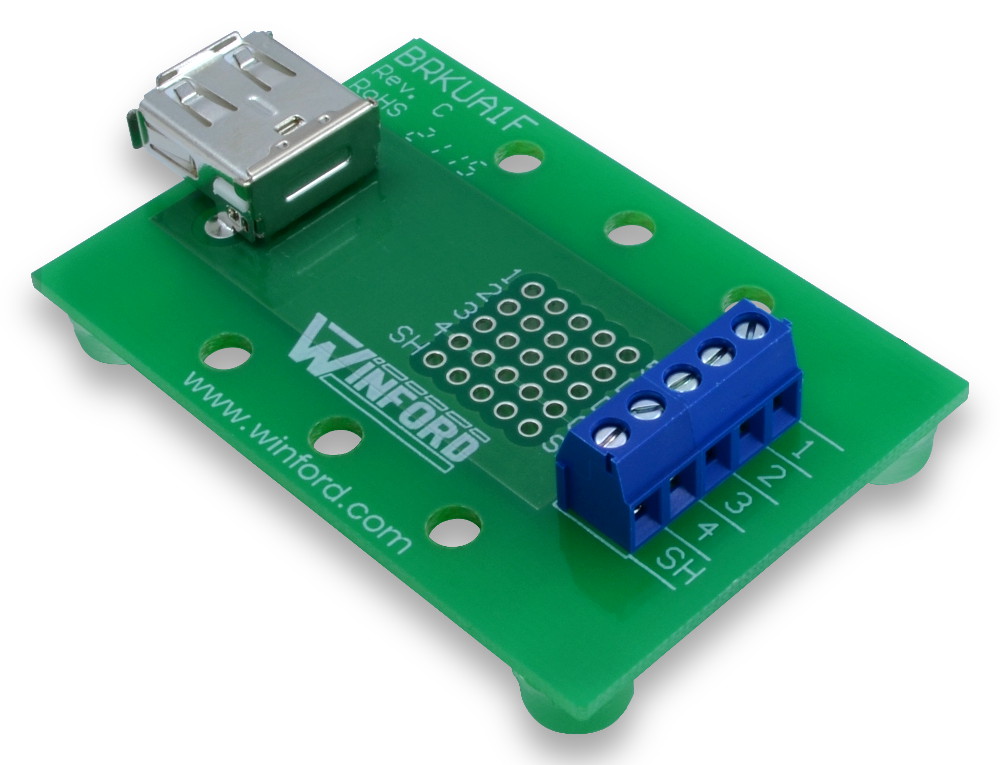

If you can't find a development board configured correctly, SchmartBoards will support hand soldering many common chip formats, including SMT devices, and even BGAs. If you aren't confident you can hand solder a component yourself, SchmartBoards will solder your IC for you for a $3.00 charge.
Thursday, July 15, 2010
Pocket Size Digital Storage Oscilloscope
DSO nano - Pocket size digital storage oscilloscope sold for only $89 at the www.seeedstudio.com Seeed Depot. It uses an ARM Cortex-M3 processor, has a 2.8" color TFT LCD with data acquisition of 1Msps, 12bits, and 4096 point storage.
 The brief manual includes a schematic and you can download the firmware from the open source dsnano project hosted at google code
Optional stand available for only $50!


Optional stand available for only $50!

Tuesday, July 13, 2010
Evaluation Board Useful for Developing and Testing USB Products

The Analog Devices iCoupler ADuM4160 USB Isolator Evaluation Board can be used as a breakout cable to test USB signals as well as its intended use to evaluate the ADUM4160 Full/Low Speed USB Digital Isolator. The board is available from Digi-Key, and other ADI distributors.
I have created my own cable for connecting a logic analyzer to USB signals in the past, but an isolation board like this would have been much easier to use and provided some protection to your prototype and development PC. For example, I could have damaged my sole development prototype when I tested it with a cheap keyboard I purchased at Best Buy. When things were not working, I assumed it was my hardware, but it turned out the keyboard's USB cable was not wired correctly.
I have a Zeroplus logic analyzer with USB decode that I would like to use with this type of adaptor board. Zeroplus sells a USB bridge without isolation, but I haven't found a distributor yet.
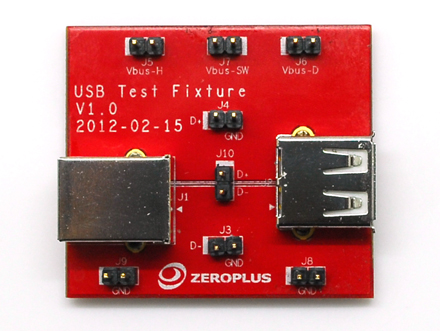
UPDATE: FriedCircuits has a few USB tester boards that are low cost like the $12 USB Tester 2.0 shown below.

Thursday, March 25, 2010
Virtual USB Analyzer
The Virtual USB Analyzer is a useful tool created by Micah Dowty and Scott Perry hosted on sourceforge.net. It's free to use and listed as a fling in vmware LABS, a diverse collection of free tools created by VMware engineers.

You have to run the analyzer in Linux but you can take the traces with any guest OS running on recent versions of VMware products. At the moment the Windows version of VMware Player is not supported, but you can use VMware Workstation, Fusion or the Player that runs on Linux. You can also load captures taken from the Linux usbmon utility and the Ellisys USB Explorer 200 hardware analyzer.
I'm using this to see how Linux configures a keyboard to diagnose a problem with an embedded USB host. I think it will also be very useful when working on a new USB device that you need to test with multiple operating systems.
Tuesday, February 2, 2010
National Instruments/Tektronix Embedded Seminars
Measurement and Analysis Techniques for Embedded System Designers will be presented by National Instruments and Tektronix in 10 U.S. cities and Toronto starting March 2010. The half day session will include talks on automated control of measurements, advanced analysis tools, and examples of enhancing embedded system testing. They will showcase Tektronix test equiptment and National Instruments LabVIEW and LabVIEW SignalExpress software. Both analog and digital techniques will be presented.
Friday, April 10, 2009
Electronic Prototype Power Supply
I have had great success bringing up new hardware with this small bench-top power supply from Lascar Electronics. The PSU 130 is inexpensive at under $90 US on Amazon.com

Subscribe to:
Posts (Atom)


