Showing posts with label computer peripherals. Show all posts

Tuesday, March 6, 2012

Tiny Serial WiFi Module Includes ARM Cortex M3

The Inventek Systems 802.11 b/g/n Serial to WiFi module makes it easy to add Wi-Fi to your embedded design.  It can be programmed from a host with a choice of serial interfaces using a simple AT command set.


These serial interfaces are provided by an STM32 ARM Cortex M3 processor as shown on the block diagram.  No software development is required for the STM32, the AT command set interface is resident in firmware.  This means your host microcontroller does not need a TCP/IP stack or RTOS.  This simplifies software development for your application - you only need to write serial I/O code to send the AT commands and process data.

An embedded wireless evaluation board is available that make it easy to connect the module to your microcontroller board for development of your WiFi application.  Both the evaluation board and the module are available from the Inventek Systems online store.


For more information on the module and evaluation board watch this video that includes a description of the functional block diagram above.


Friday, August 27, 2010

Add USB Host Support To Your MCU Design

The Maxim MAX3421E allows you to add a USB Host port to any microprocessor with an SPI interface.  This IC has recently returned to active production after being listed as not recommended for new designs.  It is offered as an Arduino shield (daughter board) from Circuits@Home and the code library for the USB Host Shield is on github.  You can find many articles on the design and use of the USB shield on the Circuits@Home blog.  The design is open hardware and you can order it from Batch-PCB as well.


For commercial projects, the MAX3421E is supported by USB Stacks from HCC-Embedded and Micro Digital.  HCC-Embedded also has an SD card module to add a USB Host to any board with an SPI capable SD card socket.  The schematics and layout are a free download from the website.

The MAX3421EVKIT-1 from Maxim can also be used for developing a USB stack for individual devices.  It can be ordered directly from Maxim ($57) or from Digikey ($62).  You can start with the MAX3421E EVKIT-1 Software and User Guide to develop your own driver for targeted devices.  I have been working with the MAX3421E with an ARM processor board and have added support for a mouse, keyboard, and hub to the design.

Thursday, July 29, 2010

New Sample Projects for Microsoft Sensors and Location Platform

Microsoft released sample code for three new projects using the Sensors and Location Platform included in Windows 7.  The projects are Graphing Accelerometer Data in Windows 7, Sensor Video-Capture Solution, and Build Your Own Game Controller.   Each project contains a white paper, and sample firmware, driver and application source.  The game controller project uses the XNA Racing Game Starter Kit and a Parallex BASIC Stamp 2-axis accelerometer board.  The Sensor & Location Platform Team Blog also has a post about the game controller project.

Tuesday, July 13, 2010

Evaluation Board Useful for Developing and Testing USB Products


The Analog Devices iCoupler ADuM4160 USB Isolator Evaluation Board can be used as a breakout cable to test USB signals as well as its intended use to evaluate the ADUM4160 Full/Low Speed USB Digital Isolator. The board is available from Digi-Key, and other ADI distributors.

I have created my own cable for connecting a logic analyzer to USB signals in the past, but an isolation board like this would have been much easier to use and provided some protection to your prototype and development PC.  For example, I could have damaged my sole development prototype when I tested it with a cheap keyboard I purchased at Best Buy.  When things were not working, I assumed it was my hardware, but it turned out the keyboard's USB cable was not wired correctly.

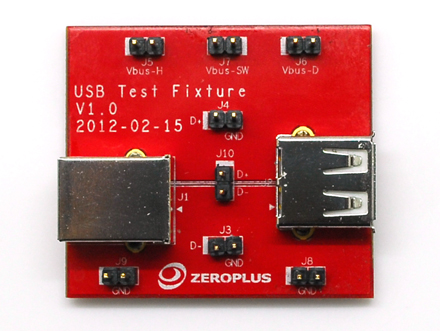
I have a Zeroplus logic analyzer with USB decode that I would like to use with this type of adaptor board.  Zeroplus sells a USB bridge without isolation, but I haven't found a distributor yet.

UPDATE: FriedCircuits has a few USB tester boards that are low cost like the $12 USB Tester 2.0 shown below.


Tuesday, April 20, 2010

New Cypress Microcontroller Features Onboard PLD

The Cypress PSoC 3: CY832 Family features 24 Universal Digital Blocks that can be configured from a library of functions or customized with Verilog code. The system includes an 8051 processor and also features an analog ADC with configurable input from every GPIO pin, an 8-bit DAC, and 2 comparators. Some devices will include USB and other interfaces.

Thursday, March 25, 2010

Virtual USB Analyzer

The Virtual USB Analyzer is a useful tool created by Micah Dowty and Scott Perry hosted on sourceforge.net. It's free to use and listed as a fling in vmware LABS, a diverse collection of free tools created by VMware engineers.

You have to run the analyzer in Linux but you can take the traces with any guest OS running on recent versions of VMware products. At the moment the Windows version of VMware Player is not supported, but you can use VMware Workstation, Fusion or the Player that runs on Linux. You can also load captures taken from the Linux usbmon utility and the Ellisys USB Explorer 200 hardware analyzer.

I'm using this to see how Linux configures a keyboard to diagnose a problem with an embedded USB host. I think it will also be very useful when working on a new USB device that you need to test with multiple operating systems.

Tuesday, January 26, 2010

Windows 7 Sensor API Targets Embedded Hardware

Microsoft has released the new Sensor API in Windows 7 to access data from external devices. The new API will still require development of a custom device driver for your hardware, but aims to reduce the complexity of applications that need to access the data. There are a number of examples applications available . Some are in the Windows 7 WDK, others are online like this one on MSDN for a motion sensor. It includes source and even firmware for a BASIC stamp microcontroller. You can build the project yourself with a Parallax passive-infrared sensor and HomeWork Board. One nice feature of the API is that it allows for virtual sensors. These can be used to develop and test apps without connecting the sensor to the PC. This can be very useful when you have seperate teams developing the Windows applications and the embedded hardware. If you have a well defined interface you should be able to switch from the virtual sensor to the final hardware without rewriting a lot of code.