Press Release: Microsoft Licenses ARM Architecture - ARM
Microsoft supports ARM in a wide range of products.
There is wide speculation about this new agreement between Microsoft and ARM.
EETimes
Network World
eWEEK.com
Friday, July 23, 2010


Friday, July 16, 2010
RepRap Free Desktop 3D Printer
RepRapWiki
RepRap from Adrian Bowyer on Vimeo.
For more 3D printers like this see my post 3D Printers for the Masses.
RepRap from Adrian Bowyer on Vimeo.
For more 3D printers like this see my post 3D Printers for the Masses.
Thursday, July 15, 2010
Pocket Size Digital Storage Oscilloscope
DSO nano - Pocket size digital storage oscilloscope sold for only $89 at the www.seeedstudio.com Seeed Depot. It uses an ARM Cortex-M3 processor, has a 2.8" color TFT LCD with data acquisition of 1Msps, 12bits, and 4096 point storage.
 The brief manual includes a schematic and you can download the firmware from the open source dsnano project hosted at google code
Optional stand available for only $50!


Optional stand available for only $50!

Open Source Hardware Gets Formal Definition
Open Source Hardware Draft Definition version 0.3 is up for review. You never know how these things can be used in the future so it might be good to review if you have an open hardware project in the works.
I would prefer there wasn't such strict requirements for documentation, technology neutrality, or source code. Generic hardware that could be used for many purposes don't seem to fit the definition for open hardware. For example, processor modules have a specific interface and are pretty self-explanatory from the schematic and data-sheets. Also, an open source hardware developer may not have the engineering staff to develop the formal documentation and source code required by the current definition. I think the software development and documentation could be left to separate open-source groups. Open-source projects like eLinux.org have reverse engineered commercial products to run useful software without access to any documentation or even schematics.
I would prefer there wasn't such strict requirements for documentation, technology neutrality, or source code. Generic hardware that could be used for many purposes don't seem to fit the definition for open hardware. For example, processor modules have a specific interface and are pretty self-explanatory from the schematic and data-sheets. Also, an open source hardware developer may not have the engineering staff to develop the formal documentation and source code required by the current definition. I think the software development and documentation could be left to separate open-source groups. Open-source projects like eLinux.org have reverse engineered commercial products to run useful software without access to any documentation or even schematics.
Tuesday, July 13, 2010
Evaluation Board Useful for Developing and Testing USB Products

The Analog Devices iCoupler ADuM4160 USB Isolator Evaluation Board can be used as a breakout cable to test USB signals as well as its intended use to evaluate the ADUM4160 Full/Low Speed USB Digital Isolator. The board is available from Digi-Key, and other ADI distributors.
I have created my own cable for connecting a logic analyzer to USB signals in the past, but an isolation board like this would have been much easier to use and provided some protection to your prototype and development PC. For example, I could have damaged my sole development prototype when I tested it with a cheap keyboard I purchased at Best Buy. When things were not working, I assumed it was my hardware, but it turned out the keyboard's USB cable was not wired correctly.
I have a Zeroplus logic analyzer with USB decode that I would like to use with this type of adaptor board. Zeroplus sells a USB bridge without isolation, but I haven't found a distributor yet.
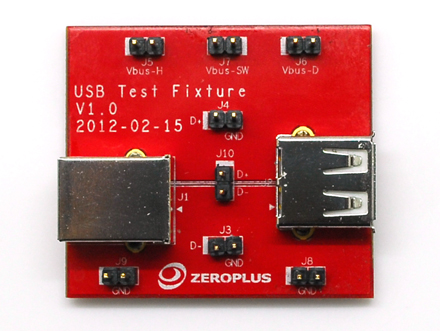
UPDATE: FriedCircuits has a few USB tester boards that are low cost like the $12 USB Tester 2.0 shown below.

Wednesday, June 30, 2010
Microsoft Revises USB Developer Documentation
The Microsoft Windows USB Core Team has finished a major review and update of the USB documentation on MSDN. As they explain in their latest bog post, USB Driver Documentation Updates in the MSDN Library, they have added more header file macro definitions, removed the unsupported USB Port Driver Interface, and added a lot of WinUSB information. There is also a new list of USB Device classes with Microsoft drivers.
Wednesday, June 16, 2010
Want to experiment with Linux? Get a Didj!

Now that the Didj has been discontinued by Leapfrog, it is sure to be on sale for much less than the cost of a similarly featured development board for Linux. You can find all of the datasheets, reference material, and source to do your Linux experimenting at the eLinux.org Didj wiki page. Below is a teardown of the toy and some processor specs, you can download the full datasheet from the site.


- 32bit CPU Embedded Architecture : 533MHz ARM926EJ with 16KByte I-Cache and 16KByte D-Cache.
- High performance 3D Graphics Accelerator
- USB 1.1 Host Controller, USB 2.0 Device, 4Ch UART
- LCD Controller, 8Ch DMA, Timer, Interrupt Controller, RTC
- SD/MMC, I2S, I2C, SSP, ADC, GPIOs, PWM, Power Manager
Saturday, June 12, 2010
Leapster's Latest Handheld ARM-Linux Gaming Platform
Leapfrog is promoting the Leapster Explorer as an all in one platform for gaming, e-books, videos and educational content. It can also function as a camera and video recorder if you purchase a camera accessory. It has an ARM processor, 512MB of flash storage, a 420x420 pixel 3.2 inch touch screen, 3D graphic processing, and a flash engine for applications and video. The image below is from an explorer review by Nicole Tanner at whattheyplay.com

The release of this new product seems related to the news that Leapster is discontinuing the Didj, another ARM processor based Linux gaming system that has been on the market only 2 years. The Didj announcement isn't going over well with parents on the Leapfrog community forum. Leapster2 owners are also upset that the cartridges will not be compatible with earlier products.

The release of this new product seems related to the news that Leapster is discontinuing the Didj, another ARM processor based Linux gaming system that has been on the market only 2 years. The Didj announcement isn't going over well with parents on the Leapfrog community forum. Leapster2 owners are also upset that the cartridges will not be compatible with earlier products.
Thursday, June 10, 2010
PIC18F Starter kit design competition
The PIC18F Starter kit design competition deadline is June 30th, 2010. The winners do not receive cash or other prizes, but have the opportunity to showcase their coding skill and advertise their company. The next version of the starter kit will include the winning designs as demos.
Tuesday, June 8, 2010
New Lattice XP2 FPGA kit available for $29
Press Release: New Low Cost Brevia Development Kit Accelerates Application Development for Popular LatticeXP2 FPGA Family

The LatticeXP2 Brevia Development Kit comes with all you need to start developing including a board, parallel JTAG cable, serial RS-232 cable, and AC adapter.
Update: This kit has been replaced by the $49 LatticeXP2 Brevia2 Board WITH LatticeXP2 FPGA: LFXP2-5E-6TN144C and on-board FTDI-based USB JTAG programmer.


The LatticeXP2 Brevia Development Kit comes with all you need to start developing including a board, parallel JTAG cable, serial RS-232 cable, and AC adapter.
Update: This kit has been replaced by the $49 LatticeXP2 Brevia2 Board WITH LatticeXP2 FPGA: LFXP2-5E-6TN144C and on-board FTDI-based USB JTAG programmer.

Subscribe to:
Posts (Atom)