Saturday, May 29, 2010

3D Printers for the Masses

Fab@Home aims to change the way we live by allowing anyone to produce custom 3D objects with a 3D printer developed at Cornell University.  Shown below is Model 2 being developed in the Cornell Computational Synthesis Lab.


You can build your own personal fabricator by following the instructions on the Fab@Home wiki or buy one at the NextFab Store.  The video below shows one in action creating a gear.
 
Here's another video showing how it can mill foam and wood.


Update: MakerBot is another 3D printer that you can make yourself for less than $1000 (Update: latest model fully assembled is almost $2000).  It creates ABS plastic models using a heated extrusion process.  You can buy a kit and spools of various colors of plastic material to create with at the MakerBot Store.


Saturday, May 22, 2010

USB Implementers Forum Closes Public Forum

I have been working on a lot of USB firmware lately and found the best forum for this was at the USB Implementers Forum website. I found a lot of useful information and some great help from the community. Up to now, the USB-IF forum message board was accessible with a free registration. Unexpectedly, the forum is now closed to the public, my recent registration denied by the site. Yesterday, I noticed all links to the forum removed from the main USB.org site and all posts older than a few weeks deleted. I posted a message asking about the forum status but now, unless there is some mistake, I won't be able to see the response and assume it's members only.

I am seeing a lot more interest in USB for embedded systems designs, including USB devices, embedded hosts, and USB 3.0.  Most developer don't need their own vendor ID, many semiconductor vendors will let you use one for free if you use their chips.  For small companies or individual developers, the $4000 cost to become a member is very prohibitive.

UPDATE: A few links to public USB forums:
Jan Axelson's USB Forum
PIC
Microchip USB Forum
SparkFun PIC USB Development Forum
Linux
http://news.gmane.org/gmane.linux.usb.general

Friday, April 30, 2010

Microsoft embeddedSpark Summer Challenge Opens

The Microsoft embeddedSPARK 2010 Challenge is now open with designs due June 8. The winner will receive a cash prize of $15000, $5000 for second and $1000 for third. The top three will present at the Embedded Systems Conference in Boston this Fall.

Tuesday, April 20, 2010

New Cypress Microcontroller Features Onboard PLD

The Cypress PSoC 3: CY832 Family features 24 Universal Digital Blocks that can be configured from a library of functions or customized with Verilog code. The system includes an 8051 processor and also features an analog ADC with configurable input from every GPIO pin, an 8-bit DAC, and 2 comparators. Some devices will include USB and other interfaces.

Saturday, April 17, 2010

Musical Instrument Amplifier Embeds a PC Inside


Orange Amps' new OPC, a combined PC and Amplifier is designed for Guitar, Keyboard, microphones and more. It includes WIFI and Guitar Effects software and will be available in June 2010. This could have a lot of uses for musicians, you could pair this with a USB MIDI controller for drums, keyboard, or wind instruments. It will be a nice compliment to USB programmable guitar effects. If successful, it will create more demand for PC connectivity in audio electronics.

Wednesday, April 14, 2010

Camera 2.0 Open-Source Digital Camera Project

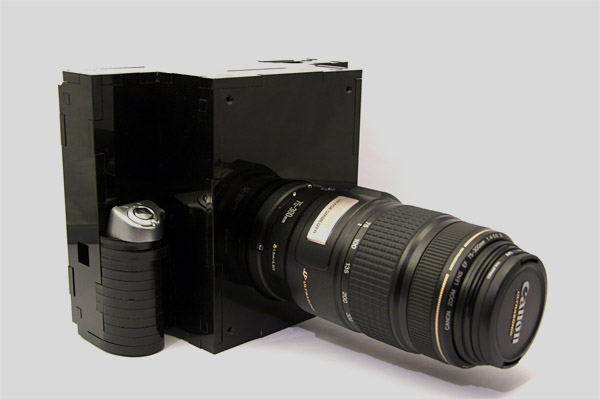
As part of the Camera 2.0 project, researchers at Stanford have developed the Frankencamera shown here, "an open-source camera platform that runs Linux, is fully programmable (including its digital signal processor) and connected to the Internet, and accommodates SLR lenses and SLR-quality sensors. Our current prototype...is constructed from off-the-shelf parts, in some cases borrowed from dead cameras. It's also ugly - hence the name."

This open-source project is being developed to help researcher gain more control of camera processing. Another open-source camera project, the Canon Hack Development Kit, allows some control through a series of enhancements, but according to the Frankencamera FAQ: "you can't use them to reprogram the camera's pre-capture sequence (metering and focusing) or to replace its post-processing algorithms (demosaicing, denoising, sharpening, white balancing, tone mapping, etc). The Frankencamera fills this gap"

The brains of the Frankencamera include a TI OMAP3 processor, an Aptina MT9P031 image sensor and an Elphel 10338 sensor board.

If the popularity of the CHDK is any indication, the Frankencamera is sure to have a cult following.

Wednesday, March 31, 2010

Low Cost CPLD Development Kit

The Lattice ispMACH 4000ZE Pico Dev Kit is on sale today for $36 at the Lattice store. Some example applications for the CPLD include adding GPIO and 5V input capability to your microcontroller. See this video for more info on consumer applications.

Monday, March 29, 2010

Altera Starter Kit Available For New Low Cost FPGA Family

Altera Cyclone IV FPGAs are now shipping in volume and are claimed to be lowest in cost and power. The Cyclone IV starter kit can be purchased at the Altera online store for $395. It includes a Gigabit Ethernet and SMA connectors. You can find more specifications and ordering information here.

Thursday, March 25, 2010

Virtual USB Analyzer

The Virtual USB Analyzer is a useful tool created by Micah Dowty and Scott Perry hosted on sourceforge.net. It's free to use and listed as a fling in vmware LABS, a diverse collection of free tools created by VMware engineers.

You have to run the analyzer in Linux but you can take the traces with any guest OS running on recent versions of VMware products. At the moment the Windows version of VMware Player is not supported, but you can use VMware Workstation, Fusion or the Player that runs on Linux. You can also load captures taken from the Linux usbmon utility and the Ellisys USB Explorer 200 hardware analyzer.

I'm using this to see how Linux configures a keyboard to diagnose a problem with an embedded USB host. I think it will also be very useful when working on a new USB device that you need to test with multiple operating systems.